A long, beautiful, unexpectedly exhausting coastal drive that quickly became one of the most memorable parts of our California road trip
Why We Chose This Route
When we first started planning our drive from Southern California to San Francisco, I knew I wanted to make the journey itself part of the experience.
Sometimes travel days feel like something to “get through” as quickly as possible, but this felt like an opportunity for a true beckoning adventure, the kind where the drive becomes just as memorable as the destination itself.
So instead of heading straight to the city, we decided to break up the drive with an overnight stay in San Luis Obispo before continuing north through Big Sur along California’s iconic Highway 1.
And honestly, what we thought would be a scenic 4-5 hour drive quickly turned into an entire full-day experience.
One thing I did not fully understand before doing this route for the first time is that once you commit to that road, you really commit to it. The winding coastal highway, narrow lanes, construction zones, slower traffic, scenic pull-offs, and constant temptation to stop means this is not the kind of drive you rush through quickly.
It is absolutely possible to do it in one long day like we did, but by the end, it became very obvious that Big Sur itself could easily be the destination for an entire separate vacation.
And honestly? I completely understand why people fall in love with it.
TLDR
- We overnighted in Apple Farm Inn before driving Highway 1 north toward San Francisco
- What was estimated as a 4-5 hour scenic drive became closer to a full-day experience once stops, traffic, construction, and slower coastal driving were factored in
- Driving south-to-north actually worked well for me personally because I am afraid of heights and preferred not being directly beside the cliff edge
- We loved the easy accessibility of several major stops including McWay Falls and the Piedras Blancas Elephant Seal Rookery
- Pfeiffer Beach was beautiful, but the narrow access road was more intense than we expected
- This drive is stunning, but it requires patience, flexibility, downloaded maps, and realistic expectations with kids
- We found many of the major viewpoints surprisingly accessible with minimal hiking required
- If your children are prone to motion sickness, preparation is extremely important for this route
Note: This post may contain affiliate links. I only share items we personally use or would genuinely recommend.
- Why We Chose This Route
- Our Overnight Stay at Apple Farm Inn
- The Reality of Driving Highway 1
- Why Driving South-to-North Worked Better for Us
- The Surprise Stop That Completely Impressed Me: McWay Falls
- The Elephant Seal Stop That Turned Into a Jurassic Park Moment
- Pfeiffer Beach: Beautiful, Stressful, and Worth It Anyway
- Bixby Bridge and Accepting That You Cannot Do Everything
- Things I’m Glad We Packed for This Drive
- Accessibility and Energy Levels
- Who This Drive Is Best For
- Watch Along
- Disclaimer
- In Closing
Our Overnight Stay at Apple Farm Inn
We arrived at Apple Farm Inn a little after midnight.
At this point, we were really just looking for a comfortable place to get a few hours of sleep before continuing the next stretch of the drive early the next morning, but I still wanted somewhere that felt cozy and memorable instead of just grabbing the nearest roadside motel.
And honestly, this ended up being exactly the kind of stop we needed.
One of the biggest reasons we booked here was practicality. They offer late-night check-in with front desk availability into the early morning hours, which gave us peace of mind knowing that even if the first part of our road trip didn’t go perfectly, we would still have somewhere waiting for us.
But beyond convenience, the property itself felt warm and welcoming in a way that immediately shifted the mood of the trip.
The rooms were spacious, cozy, and honestly much more charming than I expected for the price point. We especially loved the bay window seating area and the in-room fireplace, which ended up being one of my favorite little details of the stay.
The next morning was foggy and cold in that perfect Central California coastal way, and sitting by the fireplace before heading out onto Highway 1 felt incredibly peaceful.
We did not spend enough time there to give a full hotel review because this truly was just a quick overnight stop for us, but for what we needed, it worked perfectly.
It felt comfortable, affordable, convenient, and honestly much more magical than the budget-friendly price suggested online.
The Reality of Driving Highway 1
When we mapped our route that morning, it estimated somewhere around 4-5 hours to reach San Francisco.
That felt completely reasonable.
What we failed to account for was the reality of Highway 1 itself.
This stretch of California’s coast is incredibly winding, narrow, and slow-moving in many areas, especially with ongoing construction and alternating single-lane traffic sections following storm repairs and closures in recent years.
And once you are on that road, there really are not many quick ways to pivot or reroute.
You simply keep moving forward.
We left the hotel around 9:30 in the morning after grabbing a quick McDonald’s breakfast before getting onto the scenic route, and despite not doing any major hikes or long stops, we did not arrive at our hotel in San Francisco until around 6 PM.
And honestly? I still do not regret it.
Because the entire drive felt cinematic.
Once the morning fog burned off, we spent hours driving alongside cliffs, ocean views, rolling hills, wildlife, and some of the most dramatic scenery I have ever seen from inside a car window.
We saw cows spread across the hillsides that looked genuinely happier than most humans I know, deer grazing near the road, countless birds overhead, and eventually seals stretching farther than we could even process at first glance.
It constantly felt like there was something beautiful around the next bend.
Why Driving South-to-North Worked Better for Us
One thing I saw repeatedly online before our trip was that most people recommend driving north-to-south so that the ocean sits directly beside you for easier scenic pull-offs.
But honestly, for me personally, traveling south-to-north ended up being the better choice.
I am extremely afraid of heights.
And while the cliffs along Big Sur are breathtaking, they are also very real.
Not being directly on the ocean-side edge of the road actually helped me relax enough to enjoy the drive instead of white-knuckling the entire experience.
So if you are someone who struggles with heights or cliffside roads, I do think this direction is worth considering.
The Surprise Stop That Completely Impressed Me: McWay Falls
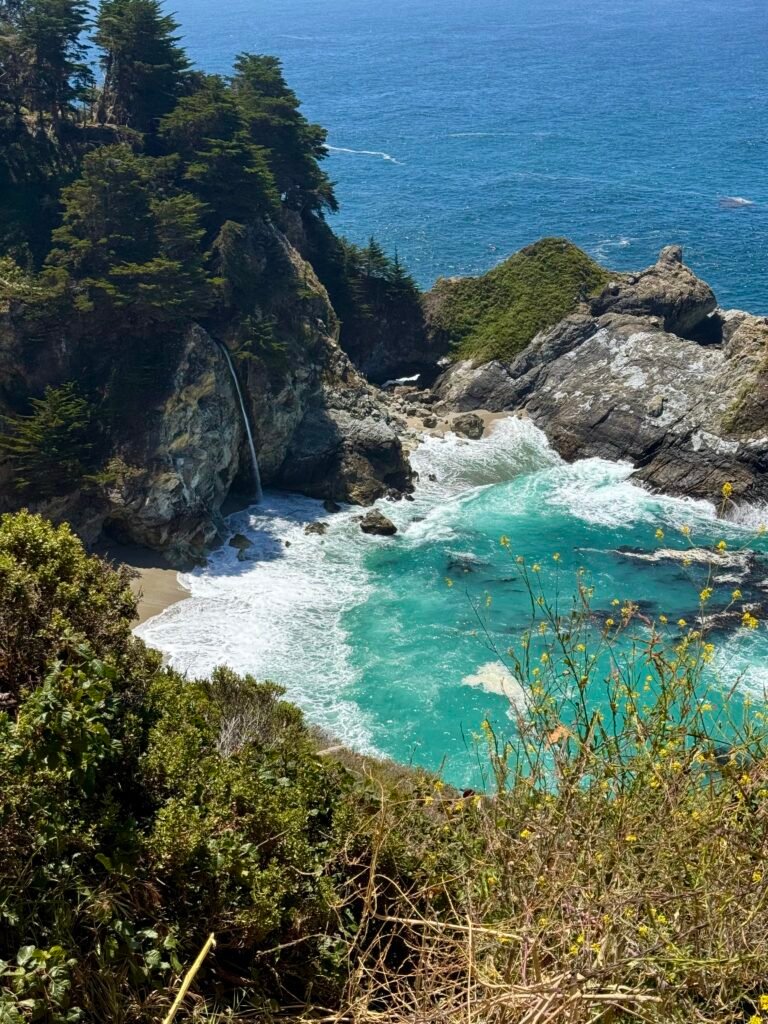
One of the coolest surprises of the entire drive was McWay Falls.
For some reason, before this trip, I had assumed it required a long hike or difficult trail access, so I had mentally categorized it as something we would probably skip.
What I was not expecting was how accessible the viewpoint actually was.
We were able to pull over, walk a short distance, take in one of the most iconic coastal views in California, snap a few photos, stretch our legs for a few minutes, and continue on our way without turning it into an exhausting stop.
And the view itself genuinely feels surreal in person.
It is one of those places that almost does not look real.
For families trying to balance scenic stops with younger kids, long driving hours, or varying energy levels, this ended up being one of the easiest and most rewarding stops of the day.
The Elephant Seal Stop That Turned Into a Jurassic Park Moment
Somewhere along the route, we stopped at the Piedras Blancas Elephant Seal Rookery.
At first, I honestly thought it would just be a quick roadside wildlife stop.
We got out of the car and immediately saw a few seals nearby and I remember thinking, “Oh, ok, cute.”
And then we looked further down the beach.
And suddenly it felt like that moment in Jurassic Park where everyone slowly turns their heads and realizes the scale of what they are looking at.
There were seals everywhere.
Farther down the shoreline.
Stacked along the sand.
Scattered as far as we could see.
The kids absolutely loved this stop, and honestly, it ended up being one of the best opportunities during the drive to fully get out of the car, stretch our legs, reset a little, and experience something memorable without requiring a ton of physical effort.
One unexpected thing we were not prepared for though?
The squirrels.
The parking area was absolutely overrun with fearless squirrels trying to get into bags, around cars, and near anyone holding snacks.
Please do not feed the wildlife.
They are already a little too comfortable around humans.
Pfeiffer Beach: Beautiful, Stressful, and Worth It Anyway
We had our hearts set on visiting Pfeiffer Beach.
And honestly, getting there ended up being much more intense than we expected.
Because we were approaching from the south, the turnoff was incredibly easy to miss. Most online guides mention this, but I still underestimated how hidden it really feels, especially since the sign is primarily visible from the opposite direction.
But the real surprise came after the turn.
The narrow two-mile access road down Sycamore Canyon was probably one of the most stressful driving moments of the trip for me.
It is tight.
Winding.
Steep in places.
And at several points it genuinely feels like only one car should fit at a time.
By the time we reached the beach parking area, I felt like we had fully committed to an entirely separate adventure.
That said, I am still glad we went.
The beach itself was smaller than I expected, and by the time we arrived the wind had started picking up, but seeing the famous purple sand in person was still incredibly cool, especially because purple happens to be my youngest’s favorite color.
We kicked our shoes off, walked along the beach for a while, listened to the waves, let the kids stretch their legs, and just existed there for a little bit before climbing back into the car.
Sometimes those quieter moments end up becoming the memories you hold onto most.
One thing that did make Pfeiffer Beach especially worthwhile for us was that it ended up doubling as one of our main restroom and reset stops during the drive. There is a paid entrance station when you arrive since this is part of the California State Park system, and when we visited, standard vehicle entry was $15. The main parking lot is not huge, but there is overflow parking available if needed, and we were relieved to find restrooms on site after spending so many hours on the road with very few reliable stopping points along Highway 1. They are more “permanent park restroom” than traditional indoor facilities, and definitely had a strong smell by the time we visited later in the day, but honestly, they were still incredibly helpful to have available in such a remote area.
If you plan on visiting multiple California State Parks throughout the year, it may also be worth looking into annual or discounted park passes ahead of time, especially for families, veterans, seniors, or visitors with accessibility needs, since there are several programs that can significantly reduce entrance costs depending on eligibility.
Bixby Bridge and Accepting That You Cannot Do Everything
Originally, we planned to stop at Bixby Creek Bridge for photos.
But by this point in the day, reality had fully set in.
Traffic was heavier.
We were running later than expected.
The scenic pull-offs were crowded.
And because we were approaching from the less popular direction, stopping safely would have been much more difficult than I anticipated.
So we made the decision to simply drive across the bridge instead.
And honestly, I think this became one of the biggest lessons of the trip.
Sometimes family travel is not about doing every single iconic stop perfectly.
Sometimes it is about recognizing when everyone is getting tired, adjusting expectations, and understanding that leaving something for “next time” is not failure.
It just means the adventure is not finished yet.
Things I’m Glad We Packed for This Drive
This is absolutely one of those road trips where preparation changes the experience.
Especially with kids.
A few things that genuinely helped us:
- Snacks and drinks that were easy to grab while driving
- Downloaded movies and shows because there is very limited cell service through much of Big Sur
- Offline maps downloaded ahead of time
- Car sickness medication and puke bags for winding roads
- A dedicated trash bag for snack wrappers and random road trip clutter
- Extra layers for changing temperatures along the coast
- Sand cleanup supplies before getting back into the car after Pfeiffer Beach
- I always am grateful to have my port-a-potty survival kit
- Portable chargers for phones and tablets
And honestly, if your kids are prone to boredom in the car, definitely bring activities beyond screens.
Even beautiful scenery starts to lose its magic a little after several straight hours on winding roads.
Accessibility and Energy Levels
One thing that genuinely surprised me about this route was how accessible many of the major viewpoints actually were.
Because we were intentionally doing more of a scenic drive-through version of Big Sur instead of a hiking-focused trip, we were able to experience several bucket-list locations without needing major physical exertion.
Many of the stops we chose allowed us to:
- park nearby
- walk short distances
- enjoy the scenery
- reset energy levels
- continue moving at our own pace
For our family, that worked extremely well.
This is obviously a completely different experience than doing longer hikes or camping through Big Sur, but if your goal is simply to experience the coastline itself, I do think this is more approachable than some people may assume.
Who This Drive Is Best For
This route is probably best for:
- families comfortable with long car days
- travelers who enjoy scenic drives more than structured attractions
- people looking to turn a travel day into part of the vacation itself
- anyone wanting to experience California’s coastline at a slower pace
This may not be the best fit for:
- travelers on a strict schedule
- anyone highly prone to severe motion sickness
- drivers uncomfortable with narrow winding roads
- people expecting a quick or efficient route to San Francisco
Watch Along
I’ll also be sharing pieces of this drive across my video content, including the coastal views, roadside stops, Pfeiffer Beach, wildlife moments, and everything in between.
This post is really here to connect all the little moments together, the pacing, the unexpected realities, and the parts that do not always fully translate through short-form video alone.
Disclaimer
Road conditions, closures, construction zones, parking availability, and weather conditions along Highway 1 can change frequently throughout the year. Always check current road conditions before beginning your drive.
In Closing
This drive ended up being so much bigger than I expected it to be.
What started as “the scenic route to San Francisco” slowly unfolded into an entire experience of its own, one filled with cliffs, wildlife, foggy mornings, winding roads, tiny roadside pull-offs, beach stops, stress, awe, exhaustion, and moments that genuinely felt unforgettable.
And honestly, even though we barely scratched the surface of what Big Sur has to offer, I completely understand now why so many people return here again and again.
Because this stretch of California does not really feel like somewhere you simply pass through.
It feels like somewhere you experience.
And even squeezed into one very long travel day with kids, it still managed to remind us exactly why we love these kinds of adventures in the first place.
The messy ones.
The ambitious ones.
The unexpectedly magical ones.
The kind that help us escape the ordinary.
If you are planning your own California road trip, you can find more of our family travel guides and long-form resources under Resources on Beckoning Adventure.

Leave a Reply